
Cape Town’s technology sector has evolved dramatically over the past decade. For years, Cape Town has been described as an emerging technology destination with a promising startup scene. Today, it has moved beyond that and is recognised as one of Africa’s most established technology ecosystems, home to multinational corporations, venture capital firms, and high-growth startups. The city has also gained increasing global recognition. Multinational companies, digital nomads, technology entrepreneurs, and investors are drawn to Cape Town’s business opportunities and exceptional quality of life.
Cape Town isn’t trying to become a tech hub anymore – it’s already one of Africa’s most established technology ecosystems. Justin Durandt, Managing Director, The Key Recruitment Group.
For many international investors and employers, it’s no longer a question of whether Cape Town can compete with other global technology centres, but rather how quickly their business can gain access to the city’s growing talent pool.
Cape Town’s Rise from Startup Ecosystem to Technology Powerhouse
The Cape Town-Stellenbosch corridor is home to more than 450 technology companies who employ more than 40,000 people. Unlike many technology hubs that are concentrated in a single city centre, Cape Town’s success is built on a corridor that combines universities, startups, investors, and multinational businesses. According to World Bank research, Cape Town is the easiest South African metropolitan municipality to do business in.
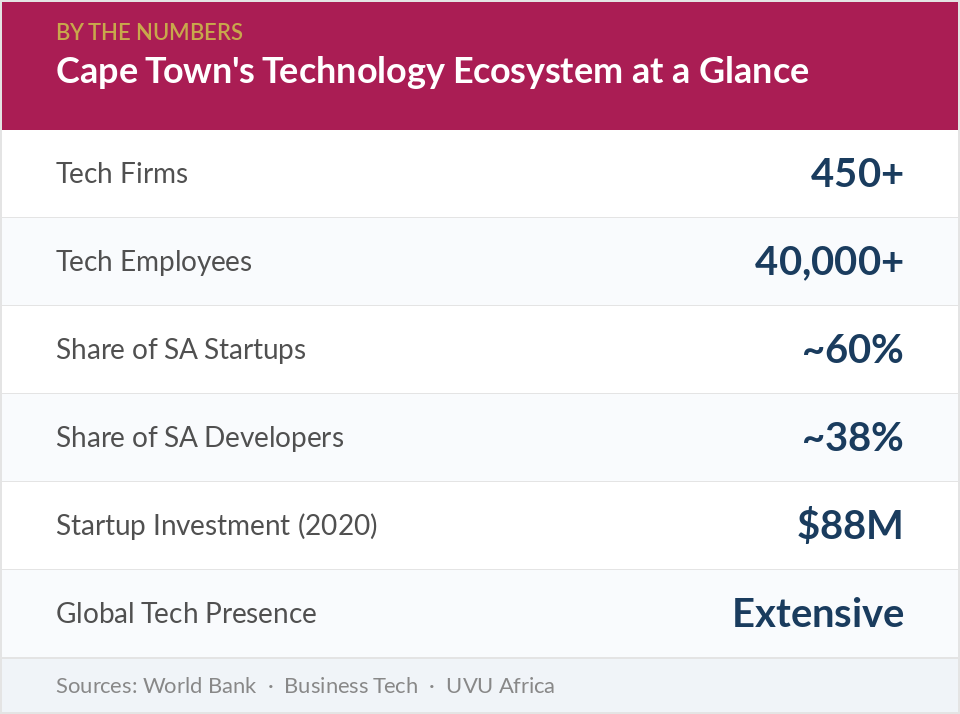
While each of these figures is impressive, together they paint a picture of an established tech ecosystem. Cape Town no longer relies on a handful of success stories – its tech system is broad, diverse and self-sustaining. Organisations such as UVU Africa (formerly CiTi) have helped nurture Cape Town’s startup ecosystem through skills development, incubation programmes, and support for entrepreneurs. Together, these institutions and support networks have created an environment where both startups and established technology businesses can thrive.
The city has a unique combination of factors that support business growth and innovation such as strong venture capital activity. Additionally, technology businesses have access to co-working spaces and extensive free public WiFi infrastructure. Underpinning favourable infrastructure and international investment are leading higher educational institutions, including the University of Cape Town and Stellenbosch University, together with a high concentration of digital training skills academies. As a result, the corridor has developed a steady pipeline of tech graduates, researchers and entrepreneurs.
Why Cape Town Is Often Called Africa’s Silicon Valley
No two technology ecosystems are identical. However, Cape Town shares many of the characteristics associated with successful global innovation hubs. For example, access to highly skilled software developers, software engineers, IT professionals, entrepreneurial talent, investment capital, and a strong pipeline of new businesses.
Cape Town has been ranked one of the world’s fastest-growing foreign direct investment regions, is an award-winning city for creating world-class infrastructure for a tech ecosystem, and has the second highest number of startups in Africa. According to Business Tech, “The Cape Town – Stellenbosch corridor contains 450 tech firms employing more than 40,000 people, making the ecosystem bigger than Nairobi and Lagos combined.” Further reinforcing Cape Town’s position as South Africa’s innovation capital is the fact that approximately 60% of the country’s startups are based in the metropolitan area.
The city has also become a popular destination for remote workers and digital nomads, creating an environment where international experience, entrepreneurial thinking, and technical expertise naturally intersect. This is because the city’s appeal extends beyond business. Cape Town’s lifestyle, natural beauty, and relatively mild climate attract both international professionals and local talent.
Companies Powering Cape Town’s Tech Economy
The strength of a technology ecosystem is often reflected in the companies it produces and attracts. The growth of the Cape Town tech hub is reflected in the calibre of companies establishing their businesses in the city. The presence of companies such as Amazon has helped reinforce Cape Town’s reputation as a destination where global businesses can successfully build and scale teams.
Local success stories include Yoco and Takealot, who have benefited from the city’s skilled tech workforce. They demonstrate that globally competitive tech businesses can be built and scaled from Cape Town South Africa. In doing so, they continue to strengthen Cape Town’s reputation as a destination for innovation and entrepreneurship. Growth across the broader ecosystem continues to be fuelled by investment and innovation from organisations such as Naspers.
Leading Companies Shaping Cape Town’s Tech Ecosystem
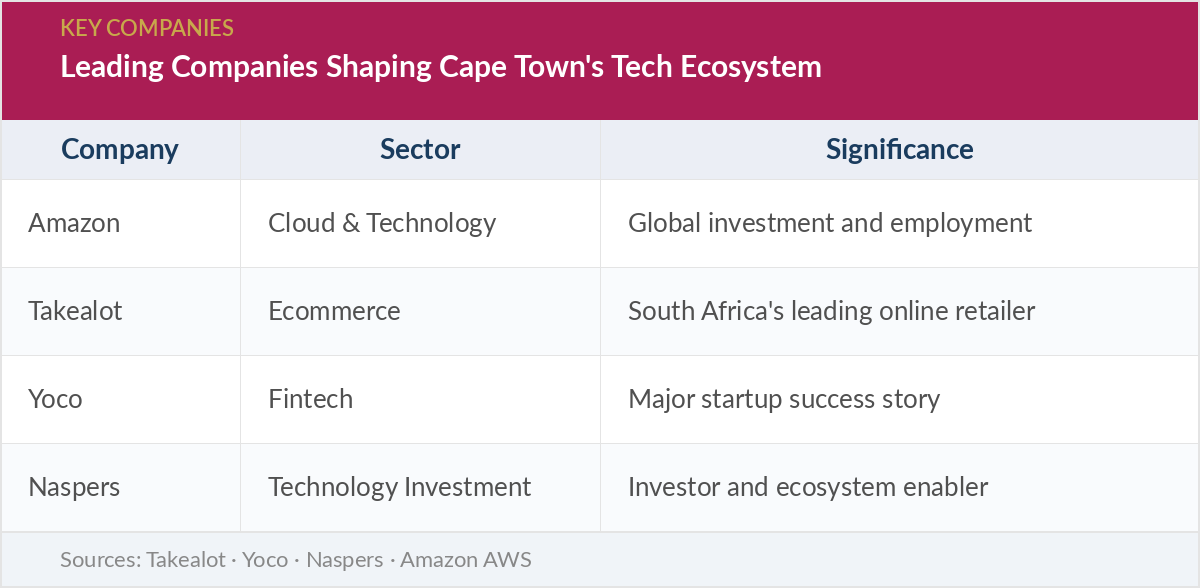
Perhaps most importantly, these businesses create a cycle of experience and entrepreneurship. Many of today’s startup founders, technology leaders, and investors previously worked for established businesses within the Cape Town tech ecosystem. Thereby creating a strong culture of knowledge sharing and mentorship. As professionals gain experience, many go on to launch their own startups, join high-growth scale-ups, or invest in the next generation of founders, further strengthening the ecosystem.
Investment Is Accelerating Cape Town’s Growth
Investment does more than fund startups. It creates jobs, attracts experienced leaders, and supports product development. It encourages talented professionals to remain in South Africa rather than seek opportunities abroad. Over the past decade, Cape Town has increasingly become the first stop for tech investors looking to gain exposure to Africa’s technology sector.
Cape Town continues to secure significant local and international investment, which is key to maintaining a thriving technology ecosystem. In 2020 disclosed investment for Cape Town startups was approximately USD 88 million. Unlike many emerging ecosystems, Cape Town has developed a mature support network of investors, mentors, accelerators, and industry partners.
Success tends to generate further success. Cape Town tech hub’s investment ecosystem has created a virtuous cycle of successful startups drawing capital, capital attracting top talent, and talent driving further innovation. And the continuation of this trend has cemented Cape Town as a leading startup investment destination.
Cape Town Tech Talent Advantage Driving Global Hiring
From software developers and data specialists to project managers and product professionals, Cape Town offers access to a deep and increasingly experienced talent pool. The city’s expertise is also expanding rapidly across high-demand fields such as artificial intelligence (AI), data science, cybersecurity, cloud engineering, and fintech, further strengthening Cape Town’s reputation as one of Africa’s leading technology hubs.
One of Cape Town’s greatest strengths is its extensive tech talent pool which is continuously topped up by graduates emerging from leading education institutions such as the University of Cape Town, Stellenbosch University, and a growing network of digital skills academies. Combined with strong English proficiency and cost-effective hiring, Cape Town continues to be a highly attractive destination for Employer of Record (EOR) hiring. Additionally, the city’s time zone alignment with the UK and Europe allows for meaningful collaboration during standard working hours. This makes Cape Town particularly attractive for offshore hiring. These advantages have helped position Cape Town as one of the most attractive locations for international companies seeking technology talent. Going forward, Cape Town will continue to play an increasingly important role in global talent acquisition.
How EOR Solutions Are Helping Global Companies Access Cape Town Talent
Foreign demand for South African technology professionals continues to rise. For many international businesses, hiring in South Africa is not a talent problem – it’s a compliance problem. By working with an established South African EOR partner, like the Key Recruitment Group, global companies can access South African technology talent without establishing a local legal entity. This flexibility has become particularly valuable as more international companies look to establish technology teams in Cape Town without the immediate cost and complexity of setting up a South African entity. Furthermore, companies often want to move quickly when they identify exceptional candidates. But establishing a local legal entity can take months. An EOR solution removes this barrier.
An EOR partnership also enables international companies to legally employ South African tech professionals while remaining compliant with local labour legislation, tax obligations and payroll requirements. For growing companies seeking software developers, engineers, project managers, product specialists, and IT professionals, an EOR service provides a faster and lower-risk route into the South African market.
Seven Key Advantages of an EOR Service
- Decreased expansion risk
- Reduced costs
- Increased rollout speed
- Streamlined payroll and benefits administration
- Insightful access to local talent
- Labour law compliance and risk mitigation
- Supports operational focus
Access Cape Town’s Tech Talent Through Key Recruitment Group
Cape Town has become one of the world’s most attractive destinations for technology hiring. From startups scaling their first offshore team to multinational organisations expanding their African footprint, Cape Town continues to offer access to some of the continent’s most sought-after technology talent. Whether you’re hiring your first South African employee or building an entire offshore technology team, having the right local partner can significantly reduce complexity and risk. Through Key Recruitment Group’s Employer of Record (EOR) solution, international businesses can hire South African talent quickly, compliantly, and without establishing a local entity.
Key Benefits of Key Recruitment Group’s EOR Solution
- Access to South African talent quickly and compliantly without establishing a local legal entity.
- Full compliance with local employment laws, payroll taxes, labour regulations, and statutory requirements.
- Reduced employment risk.
- Robust data protection and privacy compliance.
- End-to-end payroll management.
- Competitive and comprehensive employee benefits packages to attract top talent.
- Sourcing, setting up, and maintaining dedicated office space.
- Dedicated office support and equipment setup.
- Management of staff onboarding and offboarding.
- Continuous assistance with performance management, workplace issues, and employee engagement.
- Our EOR model is built to scale for business growth.
As Cape Town’s technology ecosystem continues to grow, international employers who establish a presence in the market today will be well positioned to access one of Africa’s strongest technology talent pools. Backed by more than 50 years of recruitment experience, the Key Recruitment Group has extensive local expertise with a global reach. Contact us today to access South Africa’s highly skilled technology talent.
FAQs
Why is Cape Town called Africa’s Silicon Valley?
Cape Town is often referred to as Africa’s Silicon Valley because of its concentration of technology companies, startups, investors, software developers, and innovation hubs. The city is home to more than 450 tech firms and has developed one of the continent’s strongest technology ecosystems.
Why are international companies hiring tech talent in Cape Town?
International businesses are attracted to Cape Town’s highly skilled workforce, competitive hiring costs when compared to Western markets and strong English proficiency. As well as its favourable time-zone overlap with Europe.
What technology companies are based in Cape Town?
Cape Town is home to major local and international technology businesses, including Amazon, Takealot, Yoco, and Naspers. The city also supports hundreds of startups and scale-ups across fintech, ecommerce, software development, and digital services.
What makes Cape Town attractive to technology startups?
Access to skilled talent, strong universities, venture capital activity, business support organisations, co-working spaces, and a high quality of life make Cape Town an attractive destination for startup founders and entrepreneurs.
Does Cape Town have enough software developers for global hiring?
Yes. Cape Town is home to approximately 38% of South Africa’s software developers and offers a growing pool of software engineers, IT professionals, and other highly skilled technology specialists. It also benefits from a steady pipeline of graduates from institutions such as the University of Cape Town and Stellenbosch University.
Can foreign companies hire employees in South Africa without opening a local company?
Yes. Through an Employer of Record (EOR) solution, international businesses can legally employ South African professionals without establishing a local legal entity. While remaining compliant with local labour and tax regulations.
Why are Employer of Record services becoming popular in South Africa?
Employer of Record services allow companies to hire talent quickly, reduce compliance risk, manage payroll and benefits efficiently, while allowing businesses to test new markets without the cost and complexity of setting up a local entity.
How does Cape Town compare to Nairobi and Lagos as a tech hub?
Cape Town, Nairobi, and Lagos are all recognised as leading African technology ecosystems. However, Cape Town stands out for its concentration of software developers, startup activity, investment ecosystem, business infrastructure, and access to international markets.